

Premium Phosphosite-Specific 7TM Antibodies
Your Resource for GPCR Research
Select Your Country of Delivery below

Apelin Receptor Antibodies

Close filters
No results were found for the filter!
NEW
Agonist-induced Serine351 phosphorylation of the Apelin Receptor
pS351-APLNR (phospho-Apelin Receptor Antibody)
Serine351 (S351) is major phosphorylation site of the Apelin Receptor (APLNR). The pS351-APLNR antibody detects phosphorylation in response to agonists. S351 phosphorylation is likely to be involved in efficient ligand sequestration by...
$ 375.00 *
NEW
 Agonist-induced Serine347/Serine348 phosphorylation of the Apelin Receptor
pS347/pS348-APLNR (phospho-Apelin Receptor...
Serine347/Serine348 (S347/S348) is major phosphorylation site of the Apelin Receptor (APLNR). The pS347/pS348-APLNR antibody detects phosphorylation in response to agonists. S347/S348 phosphorylation is likely to be involved in efficient...
$ 375.00 *
NEW
Agonist-induced Serine343/Serine345 phosphorylation of the Apelin Receptor
pS343/pS345-APLNR (phospho-Apelin Receptor...
Serine343/Serine345 (S343/S345) is major phosphorylation site of the Apelin Receptor (APLNR). The pS343/pS345-APLNR antibody detects phosphorylation in response to agonists. S343/S345 phosphorylation is likely to be involved in efficient...
$ 375.00 *
NEW
Validation of the APLN Receptor in transfected HEK293 cells
APLNR (non-phospho), Apelin Receptor Antibody
The non-phospho-APLNR antibody is directed against the distal end of the carboxyl-terminal tail of human apelin receptor. It also detects APLNR in cultured cells and tissue sections by immunohistochemistry. It can be used to detect total...
$ 375.00 *
NEW
Immunohistochemical identification of APLN Receptor in human pancreas
APLNR (IHC-grade), Apelin Receptor Antibody
The non-phospho-APLNR antibody is directed against the distal end of the carboxyl-terminal tail of human apelin receptor. It also detects APLNR in cultured cells and tissue sections by immunohistochemistry. It can be used to detect total...
$ 375.00 *
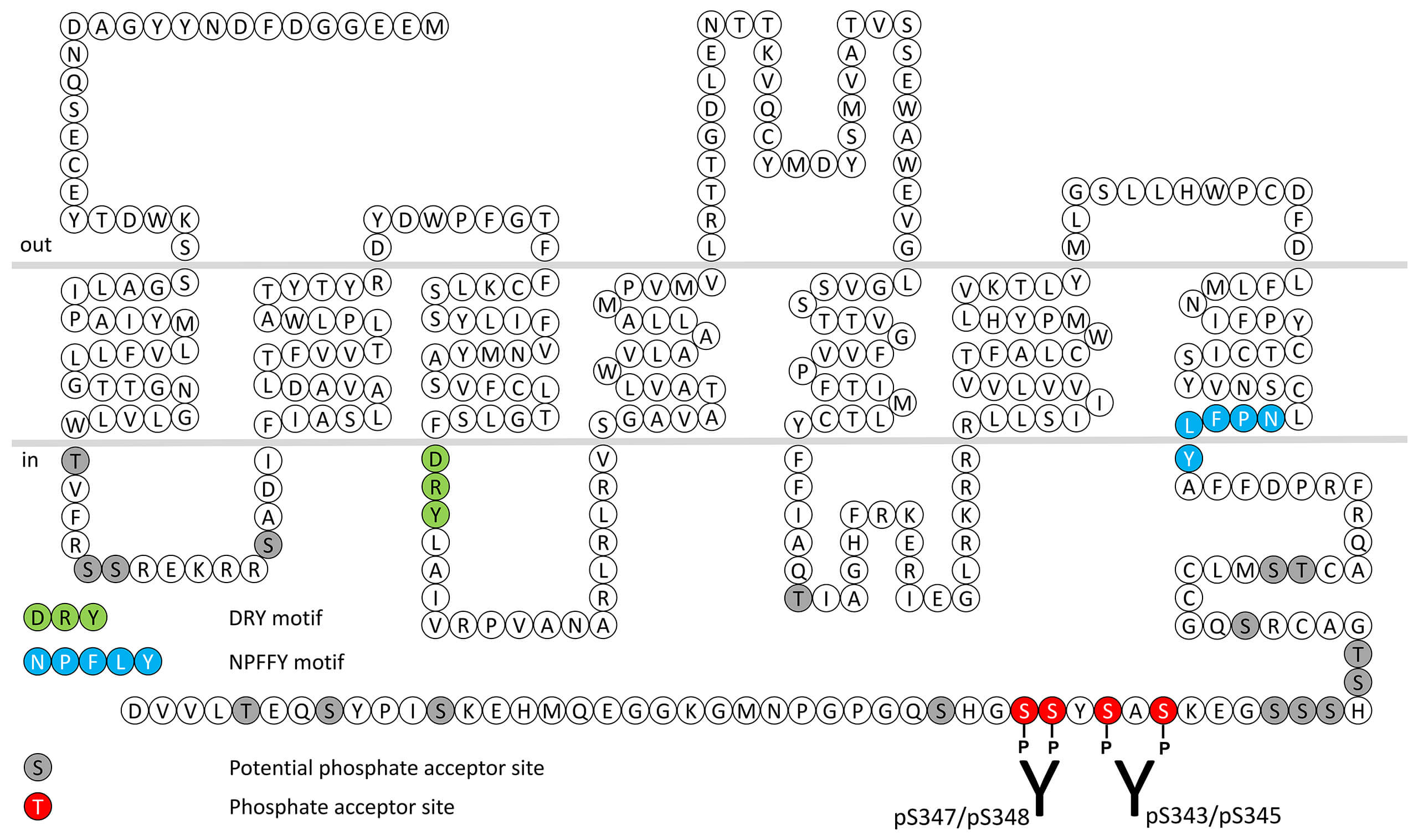
The apelin receptor (APJ), encoded by APLNR, is a class A G protein-coupled receptor activated by two families of endogenous peptides, apelin and Elabela, also known as Toddler. Apelin-36, apelin-13, and pyroglutamyl apelin-13 are among its principal endogenous agonists. The receptor primarily couples to Gi/o, inhibiting adenylyl cyclase, and can also activate ERK and PI3K–AKT signaling in a cell type-dependent manner. It is expressed in vascular endothelial and smooth muscle cells, cardiomyocytes, and selected regions of the central nervous system. In the cardiovascular system, receptor activation can promote endothelial nitric oxide-dependent vasodilation and increase cardiac contractility. The apelin receptor also contributes to fluid homeostasis, and Elabela signaling plays a role in embryonic cardiovascular development. Agonist binding can trigger β-arrestin recruitment and receptor internalization, with different apelin isoforms producing distinct rates of recycling to the cell surface. The oral small-molecule agonist azelaprag (AMG 986) reached phase 2 testing for obesity, but development was discontinued after liver enzyme elevations were observed in some participants. No apelin receptor-targeted drug is currently approved for therapeutic use. APLNR receptor desensitization, β-arrestin recruitment and internalization are regulated by phosphorylation of carboxyl-terminal serine343/serine345 (pS343/pS345-APLNR) and serine347/serine348 (pS347/pS348-APLNR). This nomenclature refers to human APLNR. This phosphorylation motif is highly conserved across species but corresponds to pS341/pS343-APLNR and pS345/pS346-APLNR in mice and rats. For more information on APLNR pharmacology please refer to the IUPHAR database. For further reading refer to:

Pitkin SL, Maguire JJ, Bonner TI, Davenport AP. International Union of Basic and Clinical Pharmacology. LXXIV. Apelin receptor nomenclature, distribution, pharmacology, and function. Pharmacol Rev. 2010 Sep;62(3):331-42. doi: 10.1124/pr.110.002949. Epub 2010 Jul 6. PMID: 20605969.

The apelin receptor (APJ), encoded by APLNR , is a class A G protein-coupled receptor activated by two families of endogenous peptides, apelin and Elabela, also known as Toddler. Apelin-36,... read more »
Close window
Apelin Receptor Antibodies

The apelin receptor (APJ), encoded by APLNR, is a class A G protein-coupled receptor activated by two families of endogenous peptides, apelin and Elabela, also known as Toddler. Apelin-36, apelin-13, and pyroglutamyl apelin-13 are among its principal endogenous agonists. The receptor primarily couples to Gi/o, inhibiting adenylyl cyclase, and can also activate ERK and PI3K–AKT signaling in a cell type-dependent manner. It is expressed in vascular endothelial and smooth muscle cells, cardiomyocytes, and selected regions of the central nervous system. In the cardiovascular system, receptor activation can promote endothelial nitric oxide-dependent vasodilation and increase cardiac contractility. The apelin receptor also contributes to fluid homeostasis, and Elabela signaling plays a role in embryonic cardiovascular development. Agonist binding can trigger β-arrestin recruitment and receptor internalization, with different apelin isoforms producing distinct rates of recycling to the cell surface. The oral small-molecule agonist azelaprag (AMG 986) reached phase 2 testing for obesity, but development was discontinued after liver enzyme elevations were observed in some participants. No apelin receptor-targeted drug is currently approved for therapeutic use. APLNR receptor desensitization, β-arrestin recruitment and internalization are regulated by phosphorylation of carboxyl-terminal serine343/serine345 (pS343/pS345-APLNR) and serine347/serine348 (pS347/pS348-APLNR). This nomenclature refers to human APLNR. This phosphorylation motif is highly conserved across species but corresponds to pS341/pS343-APLNR and pS345/pS346-APLNR in mice and rats. For more information on APLNR pharmacology please refer to the IUPHAR database. For further reading refer to:

Pitkin SL, Maguire JJ, Bonner TI, Davenport AP. International Union of Basic and Clinical Pharmacology. LXXIV. Apelin receptor nomenclature, distribution, pharmacology, and function. Pharmacol Rev. 2010 Sep;62(3):331-42. doi: 10.1124/pr.110.002949. Epub 2010 Jul 6. PMID: 20605969.

Recently viewed