Premium Phosphosite-Specific 7TM Antibodies
Your Resource for GPCR Research
Select Your Country of Delivery below

Atypical Chemokine Receptor 2 Antibodies

Close filters
No results were found for the filter!
NEW
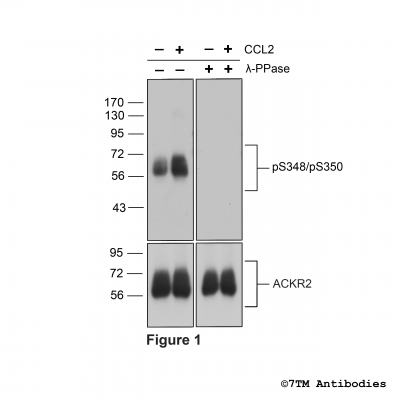
Agonist-induced Serine348/Serine350 phosphorylation of the Atypical Chemokine Receptor 2
pS348/pS350-ACKR2 (phospho-Atypical Chemokine...
Serine348/Serine350 (S348/S350) is major phosphorylation site of the Atypical Chemokine Receptor 2 (ACKR2). The pS348/pS350-ACKR2 antibody detects phosphorylation in response to agonists. S348/S350 phosphorylation is likely to be...
$ 375.00 *
NEW
Validation of the Atypical Chemokine Receptor 2 in transfected HEK293 cells.
ACKR2 (non-phospho), Atypical Chemokine...
The non-phospho-ACKR2 receptor antibody is directed against the distal part of the carboxyl-terminal tail of human ACKR2. It can be used to detect total ACKR2 receptors in Western blots independent of phosphorylation. The...
$ 375.00 *

ACKR2

Atypical chemokine receptor 2 (ACKR2), formerly known as D6 or CCBP2, is a seven-transmembrane receptor that scavenges a broad range of inflammatory CC chemokines, including CCL2, CCL3, and CCL5. It binds and internalizes these ligands without eliciting the conventional G protein-dependent signals that drive chemotaxis. Internalized chemokines are directed toward lysosomal degradation, while ACKR2 recycles to the cell surface and can capture additional ligands. The receptor undergoes constitutive endocytosis, and ligand binding can increase its availability at the cell surface through a β-arrestin 1-dependent pathway. ACKR2 is expressed on subsets of lymphatic endothelial cells, placental trophoblasts, and certain leukocyte populations. By limiting local chemokine accumulation, ACKR2 helps regulate leukocyte recruitment and can promote the resolution of inflammation. In the placenta, it helps restrict the passage of inflammatory chemokines between maternal and fetal compartments. No ACKR2-directed drug has been reported to enter clinical trials or receive approval for therapeutic use.Efficient ligand uptake by ACKR2 involves phosphorylation of carboxyl-terminal serine348/serine350 (pS348/pS350-ACKR2). This nomenclature refers to the human ACKR2. This phosphorylation motif is highly conserved across species including mouse, rat and human but corresponds to pS344/pS346-ACKR2 in mice. For more information on ACKR2 pharmacology please refer to the IUPHAR database. For further reading refer to:

Bachelerie F, Ben-Baruch A, Burkhardt AM, Combadiere C, Farber JM, Graham GJ, Horuk R, Sparre-Ulrich AH, Locati M, Luster AD, Mantovani A, Matsushima K, Murphy PM, Nibbs R, Nomiyama H, Power CA, Proudfoot AE, Rosenkilde MM, Rot A, Sozzani S, Thelen M, Yoshie O, Zlotnik A. International Union of Basic and Clinical Pharmacology. LXXXIX. Update on the extended family of chemokine receptors and introducing a new nomenclature for atypical chemokine receptors. Pharmacol Rev. 2013 Nov 11;66(1):1-79. doi: 10.1124/pr.113.007724. Print 2014. Review. Erratum in: Pharmacol Rev. 2014 Apr;66(2):467. PubMed PMID: 24218476; PubMed Central PMCID: PMC3880466.


Atypical chemokine receptor 2 (ACKR2), formerly known as D6 or CCBP2, is a seven-transmembrane receptor that scavenges a broad range of inflammatory CC chemokines, including CCL2, CCL3, and... read more »
Close window
Atypical Chemokine Receptor 2 Antibodies

ACKR2

Atypical chemokine receptor 2 (ACKR2), formerly known as D6 or CCBP2, is a seven-transmembrane receptor that scavenges a broad range of inflammatory CC chemokines, including CCL2, CCL3, and CCL5. It binds and internalizes these ligands without eliciting the conventional G protein-dependent signals that drive chemotaxis. Internalized chemokines are directed toward lysosomal degradation, while ACKR2 recycles to the cell surface and can capture additional ligands. The receptor undergoes constitutive endocytosis, and ligand binding can increase its availability at the cell surface through a β-arrestin 1-dependent pathway. ACKR2 is expressed on subsets of lymphatic endothelial cells, placental trophoblasts, and certain leukocyte populations. By limiting local chemokine accumulation, ACKR2 helps regulate leukocyte recruitment and can promote the resolution of inflammation. In the placenta, it helps restrict the passage of inflammatory chemokines between maternal and fetal compartments. No ACKR2-directed drug has been reported to enter clinical trials or receive approval for therapeutic use.Efficient ligand uptake by ACKR2 involves phosphorylation of carboxyl-terminal serine348/serine350 (pS348/pS350-ACKR2). This nomenclature refers to the human ACKR2. This phosphorylation motif is highly conserved across species including mouse, rat and human but corresponds to pS344/pS346-ACKR2 in mice. For more information on ACKR2 pharmacology please refer to the IUPHAR database. For further reading refer to:

Bachelerie F, Ben-Baruch A, Burkhardt AM, Combadiere C, Farber JM, Graham GJ, Horuk R, Sparre-Ulrich AH, Locati M, Luster AD, Mantovani A, Matsushima K, Murphy PM, Nibbs R, Nomiyama H, Power CA, Proudfoot AE, Rosenkilde MM, Rot A, Sozzani S, Thelen M, Yoshie O, Zlotnik A. International Union of Basic and Clinical Pharmacology. LXXXIX. Update on the extended family of chemokine receptors and introducing a new nomenclature for atypical chemokine receptors. Pharmacol Rev. 2013 Nov 11;66(1):1-79. doi: 10.1124/pr.113.007724. Print 2014. Review. Erratum in: Pharmacol Rev. 2014 Apr;66(2):467. PubMed PMID: 24218476; PubMed Central PMCID: PMC3880466.
Recently viewed