Premium Phosphosite-Specific 7TM Antibodies
Your Resource for GPCR Research
Select Your Country of Delivery below

Calcitonin Receptor Antibodies
Close filters
No results were found for the filter!
NEW
Agonist-induced Serine422/Serine425 phosphorylation of the Calcitonin Recepto
pS422/pS425-CT (phospho-Calcitonin Receptor...
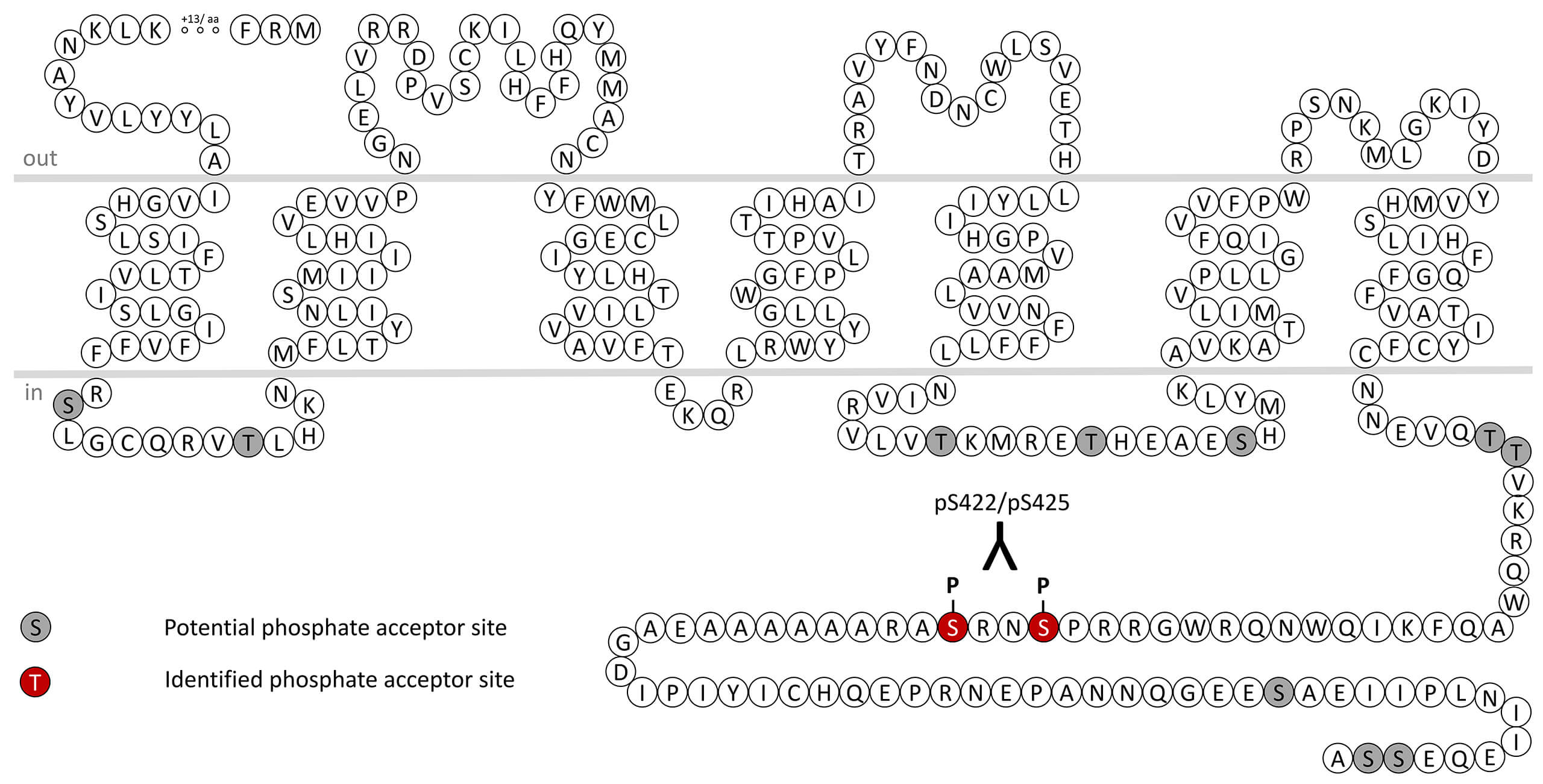
Serine422/Serine425 (S422/S425) is a major phosphorylation site of the Calcitonin receptor. The pS422/pS425-CT antibody detects phosphorylation in response to high- and low-efficacy agonists and after PKC activation. S422/S425...
$ 375.00 *
Rabbit Monoclonal
NEW
Validation of the Calcitonin Receptor in transfected HEK293 cells
CT [UMB25] (RM-non-phospho-Calcitonin Receptor...
The non-phospho-CT antibody is directed against the distal end of the carboxyl-terminal tail of human CT. It can be used to detect total CT receptors in Western blots independent of phosphorylation. The CT antibody can also be used to...
$ 495.00 *

The calcitonin receptor (CTR), encoded by CALCR, is a class B1 G protein-coupled receptor whose principal endogenous agonist is calcitonin, a peptide secreted by thyroid parafollicular C cells. CTR signals primarily through Gs to stimulate adenylyl cyclase and increase intracellular cAMP, although it can also couple to Gq/11 in some cellular contexts. The receptor is prominently expressed in osteoclasts, where its activation suppresses bone resorption. CTR expression has also been reported in the kidney and in selected regions of the central nervous system. Alternative splicing of CALCR can alter receptor signaling, and association with RAMP1, RAMP2, or RAMP3 forms the amylin receptor subtypes AMY₁, AMY₂, and AMY₃, respectively. Agonist stimulation can induce CTR internalization, and salmon calcitonin produces more sustained receptor signaling than human calcitonin in experimental systems. Salmon calcitonin is used clinically as a CTR agonist. In the European Union, injectable calcitonin is reserved for short-term use in selected cases of Paget’s disease, prevention of acute bone loss due to sudden immobilization, and treatment of malignancy-associated hypercalcemia. CT receptor desensitization, β-arrestin recruitment and internalization are regulated by phosphorylation of carboxyl-terminal serine422/serine425 (pS422/pS425-CT). This nomenclature refers to the human CT receptor. For more information on CT receptor pharmacology please refer to the IUPHAR database. For further reading refer to:

Hay DL, Garelja ML, Poyner DR, Walker CS. Update on the pharmacology of calcitonin/CGRP family of peptides: IUPHAR Review 25. Br J Pharmacol. 2018 Jan;175(1):3-17. doi: 10.1111/bph.14075. Epub 2017 Nov 28. PMID: 29059473; PMCID: PMC5740251.

Hay DL, Chen S, Lutz TA, Parkes DG, Roth JD. Amylin: Pharmacology, Physiology, and Clinical Potential. Pharmacol Rev. 2015 Jul;67(3):564-600. doi: 10.1124/pr.115.010629. PMID: 26071095.

Garelja ML, Hay D, Poyner DR, Walker CS. Calcitonin receptors in GtoPdb v.2023.1. IUPHAR/BPS Guide to Pharmacology CITE. 2023; 2023(1). Available from: https://doi.org/10.2218/gtopdb/F11/2023.1.

The calcitonin receptor (CTR), encoded by CALCR , is a class B1 G protein-coupled receptor whose principal endogenous agonist is calcitonin, a peptide secreted by thyroid parafollicular C... read more »
Close window
Calcitonin Receptor Antibodies

The calcitonin receptor (CTR), encoded by CALCR, is a class B1 G protein-coupled receptor whose principal endogenous agonist is calcitonin, a peptide secreted by thyroid parafollicular C cells. CTR signals primarily through Gs to stimulate adenylyl cyclase and increase intracellular cAMP, although it can also couple to Gq/11 in some cellular contexts. The receptor is prominently expressed in osteoclasts, where its activation suppresses bone resorption. CTR expression has also been reported in the kidney and in selected regions of the central nervous system. Alternative splicing of CALCR can alter receptor signaling, and association with RAMP1, RAMP2, or RAMP3 forms the amylin receptor subtypes AMY₁, AMY₂, and AMY₃, respectively. Agonist stimulation can induce CTR internalization, and salmon calcitonin produces more sustained receptor signaling than human calcitonin in experimental systems. Salmon calcitonin is used clinically as a CTR agonist. In the European Union, injectable calcitonin is reserved for short-term use in selected cases of Paget’s disease, prevention of acute bone loss due to sudden immobilization, and treatment of malignancy-associated hypercalcemia. CT receptor desensitization, β-arrestin recruitment and internalization are regulated by phosphorylation of carboxyl-terminal serine422/serine425 (pS422/pS425-CT). This nomenclature refers to the human CT receptor. For more information on CT receptor pharmacology please refer to the IUPHAR database. For further reading refer to:

Hay DL, Garelja ML, Poyner DR, Walker CS. Update on the pharmacology of calcitonin/CGRP family of peptides: IUPHAR Review 25. Br J Pharmacol. 2018 Jan;175(1):3-17. doi: 10.1111/bph.14075. Epub 2017 Nov 28. PMID: 29059473; PMCID: PMC5740251.

Hay DL, Chen S, Lutz TA, Parkes DG, Roth JD. Amylin: Pharmacology, Physiology, and Clinical Potential. Pharmacol Rev. 2015 Jul;67(3):564-600. doi: 10.1124/pr.115.010629. PMID: 26071095.

Garelja ML, Hay D, Poyner DR, Walker CS. Calcitonin receptors in GtoPdb v.2023.1. IUPHAR/BPS Guide to Pharmacology CITE. 2023; 2023(1). Available from: https://doi.org/10.2218/gtopdb/F11/2023.1.

Recently viewed